Beyond the Checklist –Our New Book About Patient Safety
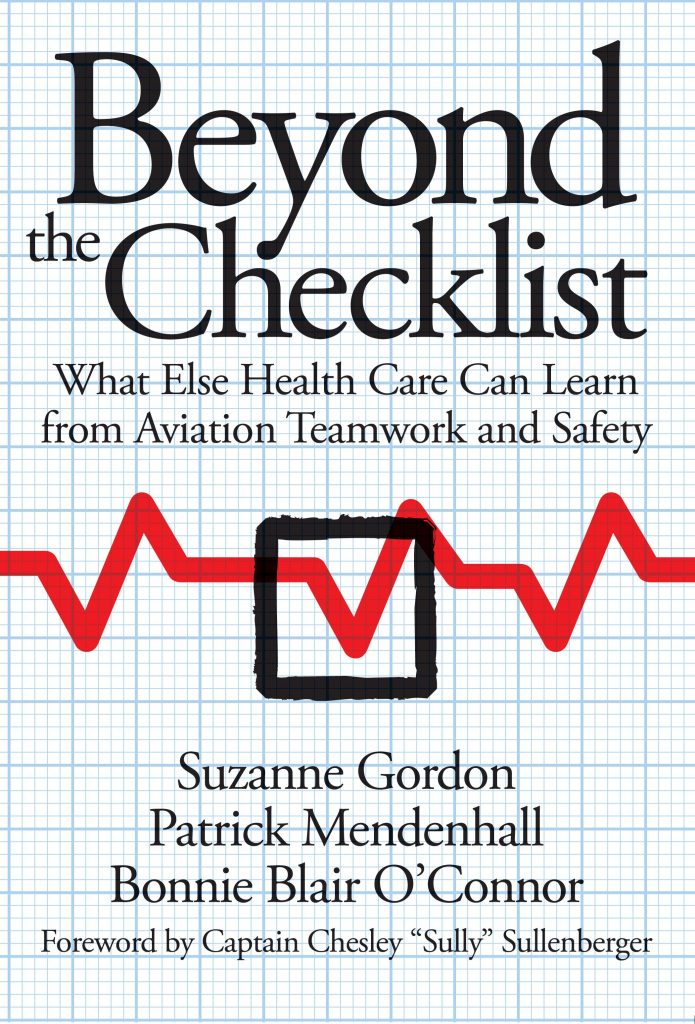
I am delighted to let readers of this blog know about our new book, Beyond the Checklist: What Else Health Care Can Learn from Aviation Safety and Teamwork, which was just published in the series on The Culture and Politics of Health Care Work that I co-edit for Cornell University Press. I wrote the book with international commercial airlines pilot Patrick Mendenhall and medical educator and ethnographer Bonnie Blair O’Connor.
As the title suggests, the book is a very detailed look at the aviation safety model (ASM) known as Crew Resource Management( CRM) or, in its contemporary iteration, Threat and Error Management(TEM). We were delighted that Captain Chesley “Sully” Sullenberger agreed to write a foreword for the book. The book is designed to help people in critical industries like healthcare understand how aviation became safer and how they can adapt the aviation safety model (ASM) to their work — particularly when it is in healthcare, which should be a high reliability industry but which has a ways to go to attain that status.
Transparency in Healthcare? Check out the Sugar Bowl website
Anyone interested in transparency in healthcare should check out the Sugar Bowl website under chairlift safety program, under inspiration. So right on the website of this famous ski area in California is the story of an accident that killed seven-year-old John Marco Henderson.
As the article explains, “Last December our community suffered a great loss. John Marco Henderson, age 7, died after falling from the Mt. Lincoln chairlift while skiing with the Sugar Bowl Ski Team. Over the past 10 months, Sugar Bowl Corporation and Sugar Bowl Ski Team have worked with John’s parents to investigate how this accident occurred and determine what steps could be taken to prevent a similar tragedy. At Sugar Bowl, safety remains our highest priority.”
The article then goes on to detail what could be pieced together about what happened to the boy and, in great detail, discusses what the ski area is doing in response. The website acknowledges that there were problems with the lifts and the ski area does not in any way try to shirk its responsibility — both in the accident and in fixing the problems that may have caused it. “Ultimately our safety practices were insufficient to prevent this tragedy,” the article reads. Although the article acknowledges problems, it does so without apportioning blame or scapegoating anyone.
“As a result of this tragedy,” the resort explains, “we reviewed existing policies, procedures and best practices relating to the loading, riding and unloading of the chairlifts at Sugar Bowl. We have implemented a comprehensive Safety Program that includes the following changes: restraining bars will be lowered for all minors under 51 inches in height (including equipment); increased adult supervision of children in the ski school and on ski team; and installation of cameras to continuously monitor and improve chairlift loading practices. The Safety Program will be distributed widely and is available on the Sugar Bowl website.”
Imagine seeing something like this on a hospital website. How remarkable would that be?
Reading this people might think, Suzanne has lost it. Does she really imagine that any hospital or health care professional would actually publicly post an acknowledgment of safety problems and how they are being remedied? But no, I have not lost my mind. This kind of behavior is common in high reliability organizations (HROs). In our book Beyond the Checklist: What Else Health Care Can Learn from Aviation Safety and Teamwork, we describe the kinds of reporting programs and information sharing that have made flying safer than it has ever been. These kinds of programs can be adapted to healthcare. Patients know healthcare isn’t safe. They know hospitals are dangerous places. What they cannot do is protect themselves if they don’t know what to do and don’t have guidance and assistance from professionals as they try to protect themselves.
Right now, too much of patient safety is being outsourced on to patients themselves. We are asked to check our meds, to make sure no one gives us the wrong dose, a more — rather than less — invasive operation. We are asked to ask professionals if they have washed their hands. And everyone expects us to do this — even when we’re unconscious — and some actually blame us if experience a medical error or injury because, according to the outsourcing logic, we have not been vigilant enough. It was our own fault. It’s kind of like asking an airplane passenger not only to listen in to the air traffic control channel but to make sure the captain has, in fact, descended to 25,000 feet.
Patients — like child skiers — can only do so much to protect themselves. Yes, we should do what we can. We should be vigilant. But when we are most vulnerable, we also the most unable to act to protect ourselves, and if we’re lucky enough to have family and friends nearby, they too may be unable to effectively advocate for us. One has only to read the last two Narrative Matters selections in the journal Health Affairs by Beth Swan and Jonathan R. Welch to discover how difficult it is for even seasoned professionals to protect their loved-ones.
Although I will write more on these two stories later, the take home message is, without the kind of high level committment exhibited by those who lead (the kind of high-level commitment exhibited by Sugar Bowl) institutions as well as efforts to involve staff at every level, patients will never be safe.
JAMA Book Review of Frederick Barken’s Out of Practice
Last year, our series at Cornell University Press — The Culture and Politics of Health Care Work — published Frederick Barken’s excellent book about the frustrations of primary care medicine in America. JAMA agrees with us about the value of this new book. The reviewer highlights all the right things even though he sees the glass as a bit fuller than Barken does. This is a book well worth reading, particularly in light of President Obama’s reelection and thus the coming implementation of the Affordable Care Act.
How to Stop “Never Events” in Health Care
In her December 20th blogpost on WonkBlog, Sarah Kliff reports on a study from the Journal Surgery which documents that surgeons have left 4,857 objects in patients over the last two decades. The study by researchers at Johns Hopkins University also documents that doctors operate on the wrong body site at least 20 times a week, and that they also perform the wrong procedure on a patient about 20 times a week. After analyzing data from malpractice cases, the researchers estimate that 80,000 of these “never events” actually happened in the past two decades. The study is based on data from malpractice claims. Thus, it may underestimate the kind of problems catalogued since not every “never event” becomes a legal event.
These “never” events could be dramatically reduced if surgeons used checklists – the kind that we have written about in our new book Beyond the Checklist: What Else Health Care Could Learn from Aviation Safety and Teamwork. They could also be reduced if hospitals cracked down on the minority of surgeons responsible for such problems. Doctors who leave instruments and other things inside the patient, or who operate on the wrong patient or body site have already had malpractice claims brought against them or are younger–and thus less experienced–surgeons.
This sorry record highlights the fact that healthcare facilities do not offer the kind of high reliability that saves lives and limits harm. They are not what Karl Weick and Kathleen Sutcliffe refer to in their excellent book, Managing the Unexpected: Resilient Performance in the Age of Uncertainty, as high reliability organizations (HROs).
The study by Johns Hopkins researchers explains that using mechanisms like timeouts (calling a time out to make sure that they are operating on the right person, at the right time, and on the right site) as well checklists in the OR helps to reduce medical errors and injuries. Errors and injuries are also reduced when surgeons take the time to brief and debrief OR staff and to flatten hierarchies among OR team members. It’s much better for patient safety, if your surgeon is on a first name basis with the OR staff – as in “call me Tom or Joanne, instead of Dr. Smith and Dr. Patel.” Why? Because safety advocates have found that it’s a whole lot easier to tell Tom or Joanne that they are about to make a mistake than to tell Dr.Smith or Dr. Patel. Which is why, airplane crews all use their first name and why the captain of the ship is required to brief the crew, use checklists, and debrief after any near misses or problem. This has made flying a whole lot safer than it used to be when toxic hierarchies were the norm and captains were kings who never listened to – or solicited – input from their crews, whether in the cabin or flight deck.
The kind of transformation that took place in aviation should, as Johns Hopkins researchers explain, serve as a guide for hospitals – particularly for surgeons. But today, hospitals have an amazing tolerance for physicians who continue to practice unsafely. Surgeons are often regarded as the “geese who lay the golden eggs.” Challenge them and they will go somewhere else to roost. I have seen hospital administrators sit passively by as staff tell them about physicians who refuse to use checklists and time outs, follow safety protocols, like washing their hands, or using masks to maintain sterile conditions. I have watched as nurses tell their managers or high-level administrators that they are afraid to call a particular surgeon in the middle of the night if they are unclear about a patient’s orders. (This is a potential catastrophe, since clarification of an order may make the difference between life and death for the patient). And yet no one does anything about that doctor, whose behavior, by the way, hospital higher ups may have known about for years.
I have heard surgeons tell other physician safety advocates that they couldn’t possibly flatten the hierarchy in the OR because their patients want them to be referred to as “Dr. this or that.” This in spite of the fact that most patients are unconscious in the OR or too snowed on anti-anxiety meds to care about what their doctor is called. (When I hear physicians explain that patients insist upon the maintenance of such toxic hierarchies I always wonder how these physicians know what their patients preferences really are. Have they actually explained that a flatter hierarchy is safer to their patients? After hearing such an explanation have patients actually argued that they prefer status-enhancing formality rather than practices that enhance their safety?)
In aviation, reports like those done by Johns Hopkins researchers produced concrete results – and fast. In healthcare there is certainly a path to safety – a way. What’s missing seems to be the will to challenge the few physicians who harm so many patients and who also give their colleagues a very bad name.
Please Read Adam Reich’s New Article on Michigan Labor Law
I have had the pleasure to edit sociologist Adam Reich’s excellent book With God on Our Side about the struggle for union representation at a Catholic hospital run by nuns in Santa Rose, California. I cannot recommend it enough. Reich is a wonderful writer and astute healthcare commentator. He has written an excellent new piece on the healthcare implications of Michigan’s new “right to work” law. The piece can be found at Beyond Chron and is entitled “Michigan’s Attack on Unions Undermines Public Health.”